


"If you're not prepared to be wrong, you'll never come up with anything original." (Sir Ken Robinson)
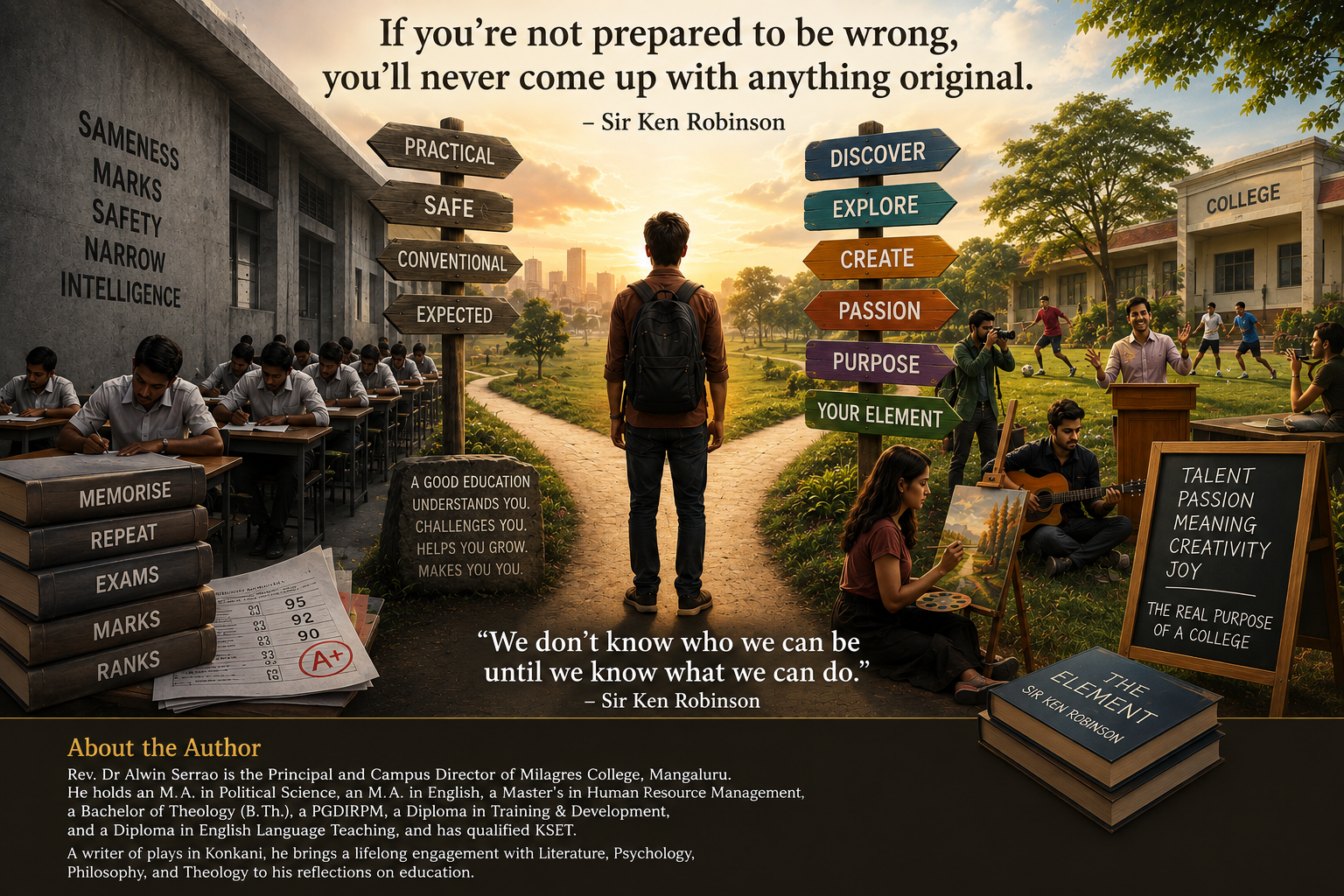
Sir Ken Robinson wrote a book called The Element. His idea is simple: people do their best and happiest work when their natural talent meets what they truly love doing. He says most of us never find this place. Not because we lack ability, but because our schools and colleges are not built to help us discover it. They were designed for a different age, one that valued sameness, marks, and a narrow idea of what counts as "intelligence." In the process, many students lose touch with their own creativity.
This idea matters greatly for higher education in India today. Our colleges still reward students who can memorise and repeat information more than students who can think, question, imagine, or create. A student who is talented in art, music, sport, or public speaking is often quietly pushed towards subjects seen as more "practical" or "safe." Many young people finish their degrees without ever discovering what they are truly good at, or what they truly enjoy.
Robinson is not asking us to lower our standards. He is asking us to widen our idea of what education should achieve. Students learn best when their work feels meaningful, not just useful for a job. A good education should also help students understand themselves, ask deeper questions, and grow as complete human beings, not just as future employees.
For our colleges, this means making more space, in our classrooms and in our campus life, for students to explore what genuinely interests them, even when it falls outside the usual academic path. India's National Education Policy, with its focus on flexible and multidisciplinary learning, gives us a real opportunity. The question is whether we use this opportunity to simply add more subjects, or to truly help each student find their own Element. This, I believe, is the real purpose of a college: helping students to find their Element.
"We don't know who we can be until we know what we can do." (Sir Ken Robinson)