



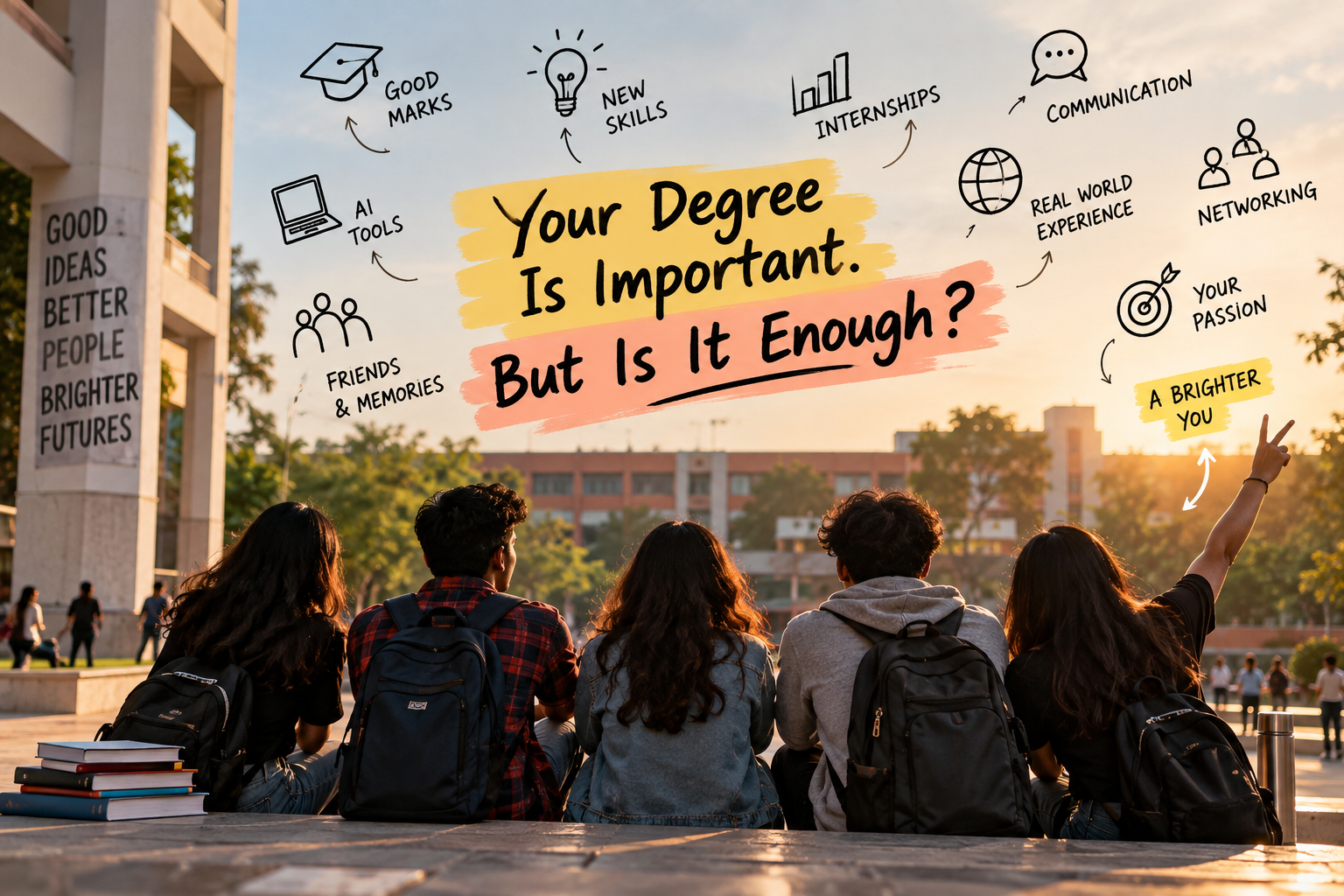
Your Degree Is Important. But Is It Enough?
College life can sometimes feel like a routine.
Wake up. Get ready. Rush to college. Attend classes. Submit assignments at the last possible moment. Worry about attendance. Write exams. Wait for results.
And somewhere between all of this, we are supposed to figure out what we want to do with the rest of our lives.
Easy, right?
The truth is, college today is about much more than getting a degree. Your degree is important, but when you finally step outside college and start looking for opportunities, you quickly realise that almost everyone standing beside you has one too.
So what makes you different?
Marks Matter, But They Don't Tell Your Whole Story
We've grown up hearing about the importance of marks.
And yes, marks do matter. They can open doors to higher studies, placements and other opportunities.
But marks don't always show how well you communicate, how confidently you handle a difficult situation, whether you can work with a team or how quickly you can learn something new.
Think about the people you admire in your own class.
Sometimes, it isn't the person with the highest marks.
It might be the person who can confidently walk onto a stage. The one who somehow manages an entire event when everything is going wrong. The friend everyone calls when they need help with technology. Or the student who can walk into a room full of strangers and start a conversation without looking terrified.
Those are skills too.
And they matter more than we sometimes realise.
Learn Something Outside the Syllabus
Your syllabus gives you a foundation. Don't ignore it.
But don't stop there either.
Learn Excel. Improve your communication. Try designing something. Learn how AI tools work. Take photographs. Edit videos. Learn another language. Try public speaking. Complete an online course.
You don't have to become an expert in everything.
Just start with something you're genuinely interested in.
Even 20 or 30 minutes spent learning something regularly can make a huge difference over time.
You might not notice the change immediately.
But six months later, you probably will.
About AI...
Let's talk about the thing everyone is suddenly using.
Artificial Intelligence.
AI isn't something students need to fear. It can actually be an incredible learning tool.
You can use it to understand difficult concepts, practise interview questions, improve presentations, brainstorm ideas, learn new skills and explore topics far beyond your classroom.
But there is a small problem.
If AI is doing all your thinking for you, you're not really learning much.
We've probably reached the point where a student can generate a ten-page assignment without understanding page one.
That's impressive technologically.
Academically? Slightly less impressive.
Use AI to help you think, not to avoid thinking.
Because someday there won't be a copy-and-paste button sitting across the interview table.
Don't Wait Until Your Final Year
This happens every year.
Students reach their final semester and suddenly realise they need a résumé, LinkedIn profile, certificates, internship experience and interview skills.
Then everything becomes urgent.
You don't need to wait.
Start building these things while you're still studying.
Participate in competitions.
Volunteer during college events.
Attend workshops.
Take internships seriously.
Create a LinkedIn profile.
Talk to people from different industries.
Ask questions.
Even organising a small college event can teach you things a textbook cannot.
You learn how to work with people.
You learn how to solve problems quickly.
And, most importantly, you learn what happens when five people say, "Don't worry, I'll do it," and nobody actually does it.
That's practically a management course by itself.
Talk to People
This sounds ridiculously simple, but it matters.
Talk to your classmates.
Talk to your lecturers.
Talk to seniors.
Talk to professionals when you get the opportunity.
Ask people how they started their careers.
Ask what mistakes they made.
Ask what skills helped them.
Some of the best career advice you'll ever receive may come from a random ten-minute conversation.
Networking doesn't always mean wearing formal clothes and exchanging business cards.
Sometimes it simply means being curious enough to have a conversation.
Your Online Presence Matters Too
Whether we like it or not, we live online.
Instagram, LinkedIn, YouTube and everything else have become extensions of how people see us.
That doesn't mean your Instagram suddenly needs to become painfully professional.
Post your trips. Post your friends. Post your terrible food photography.
Be yourself.
But remember that your digital presence can also show what you're capable of.
If you organise an event, share it.
If you win something, share it.
If you complete a course, add it to LinkedIn.
If you create something you're proud of, put it out there.
You never know who might see it.
And Please, Actually Enjoy College
With all this talk about careers, skills and the future, there's something else worth remembering.
You are living through a part of your life that won't come back in quite the same way.
There will be assignments you complain about.
Classes you desperately want to end.
Events that become chaotic.
Friends who annoy you.
Days when absolutely nothing goes according to plan.
But years later, those might be the stories you remember.
You'll probably forget the marks you scored in one random internal exam.
You won't forget the people who made college memorable.
So prepare for your future, but don't become so obsessed with tomorrow that you forget to enjoy today.
One Small Challenge
Before this week ends, do one thing for your future.
Nothing dramatic.
Update your résumé.
Create a LinkedIn account.
Apply for an internship.
Learn something new.
Talk to someone working in a career you're interested in.
Volunteer for something.
Start the idea you've been saying you'll start "soon."
Because careers usually aren't built through one massive decision.
They're built through hundreds of small ones.
Your degree will eventually be printed on a certificate.
But the confidence you gained, the mistakes you made, the people you met, the skills you developed and the experiences you collected along the way won't fit onto that piece of paper.
And maybe that's the most important part of college.
Not just what you studied, but who you became while studying it.